
WELCOME BONUS 300%
UP TO €2000 + 100
FREE SPINS
UP TO €2000 + 100
FREE SPINS
Home → Blackjack
Blackjack at Eternal Slots Casino: Variants, Rules and Payouts
Chose Wrong Table for 5 EUR Bankroll
The Quantum Blackjack Plus Live table from Playtech allows bets ranging from 1 to 5,000 EUR, making it accessible for small bankrolls. This minimum stake of 1 EUR fits a tight budget better than the Infinite Blackjack limit of 1 EUR from Evolution. Players must account for the 99.57% RTP when calculating potential returns on these low-stake wagers over time.
Side bets in Quantum Blackjack offer multipliers up to 1,000x on three-card combinations totaling 21 points, which drastically increases volatility. Such high variance requires a larger reserve than a mere 5 EUR can provide during losing streaks. The standard deviation remains manageable compared to slots, but the risk of busting the initial deposit is real without proper strategy.
Infinite Blackjack by Evolution features unlimited seats and four side bets like Any Pair or Hot 3, each with distinct house edges. These optional wagers often carry higher costs than the main game, eroding the bankroll faster. A player starting with 5 EUR should avoid these additions to preserve capital for the base game with its 99.47% RTP.
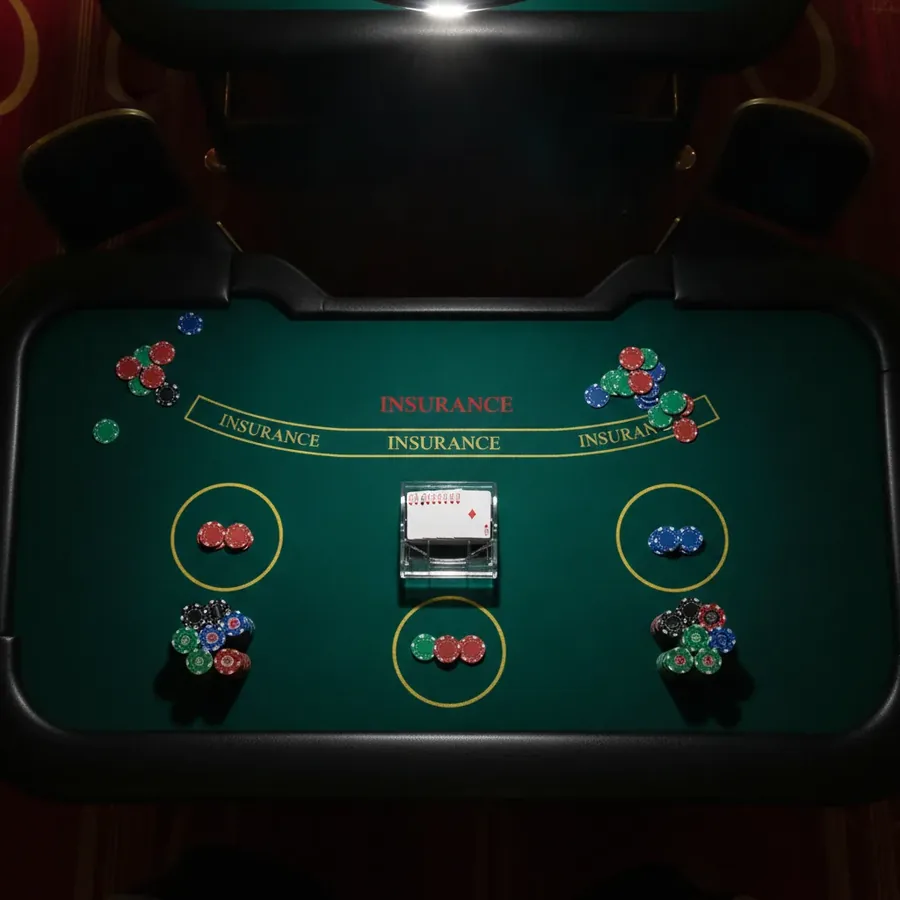
Error insurance: 7 percent additional house edge
Blackjack Insurance carries a steep 7.47% house edge, significantly harming long-term profitability for players who accept it frequently. This figure stands in stark contrast to the 0.28% advantage found in Liberal Vegas Strip rules with optimal play. Accepting insurance on every dealer Ace adds substantial cost that basic strategy explicitly advises against except when counting cards.
The payout for insurance is 2:1, but this does not offset the mathematical disadvantage inherent in the side bet structure. With six to eight decks in play, the probability of the dealer holding a ten-value card makes the bet unfavorable. The 6–8 deck configuration ensures the house maintains its significant lead over the player's expected return on this specific wager.
Comparing the 7.47% edge to the 0.15% advantage of single-deck games highlights the severity of this common mistake. Even the 0.46% edge in six-deck games is far superior to taking insurance under standard conditions. Players relying on basic strategy will see their bankroll deplete much faster if they ignore the advice to decline this bet.
Even Money only possible with Dealer Ace
When the dealer shows an Ace, players with blackjack may opt for even money, which guarantees a 1:1 payout immediately. This option is mathematically equivalent to taking insurance on your own hand, locking in a profit regardless of the dealer's outcome. The rule applies specifically to the moment the dealer checks for blackjack after revealing the upcard as an Ace.
This guarantee removes the possibility of winning 3:2 if the dealer does not have blackjack, reducing potential earnings. In games paying 3:2, such as Liberal Vegas Strip, skipping even money yields a higher expected value over time. The 1:1 payout is lower than the 1.5:1 return available when the dealer fails to match the player's natural twenty-one.
The decision impacts the overall house edge, which sits at 0.28% for liberal rules versus higher percentages elsewhere. By accepting even money, you effectively convert a high-variance win into a certain, smaller gain. This strategy is rarely optimal unless the player is tracking cards and knows the remaining deck is rich in ten-value cards.
Infinite Blackjack uses the Six Card Charlie
Infinite Blackjack by Evolution does not feature a Six Card Charlie rule, despite common misconceptions about live dealer variants. The game focuses on unlimited seats and side bets like Bust It, which pays based on the dealer busting with multiple cards. Players should verify specific rule sets before playing, as missing this nuance affects strategy expectations for this particular title.
Standard blackjack rules apply here, where reaching twenty-one with fewer than six cards pays 3:2 or 1:1 depending on the hand. The absence of a Six Card Charlie means players must aim for strong totals rather than relying on drawing out to seven cards. This contrasts with some niche variants that reward extended hands, altering the optimal approach to soft hands.
The RTP of 99.47% assumes perfect basic strategy adherence without any special six-card bonuses influencing the calculation. Side bets add excitement but increase the house edge, so focusing on the main game preserves the theoretical return. Understanding these distinctions helps players manage their bankroll more effectively across different live casino offerings from Evolution.
Splitting tens costs expected value: better stand
Splitting tens breaks a strong hand of twenty into two weak hands starting with ten, statistically lowering the expected value. Standing on twenty wins against most dealer upcards, while splitting forces the player to rebuild two separate positions from scratch. This error is common among beginners who misinterpret the flexibility of split rules offered in various blackjack versions.
The house edge increases when players split tens instead of standing, as the combined EV of two ten-starting hands is less than one twenty. In games allowing resplitting, such as those with DAS, the temptation grows, but the mathematical reality remains unchanged. Conservative play dictates keeping the twenty intact to maximize the probability of beating the dealer's final total.
Liberal Vegas Strip rules allow resplitting and doubling after splits, yet splitting tens remains suboptimal compared to standing. The 0.28% house edge is achievable only through correct decisions on all hands, including rejecting the split on pairs of tens. Deviating from basic strategy on this specific hand erodes the long-term advantage provided by favorable table rules.
Blackjack variants at a glance
| Variant | Payout | House edge | Rule | Bet range |
|---|---|---|---|---|
| Blackjack 6 Decks, S17, DAS, DOA, Auszahlung 3:2, Basisstrategie | 99.54% | 0.46% | Dealer steht auf Soft 17; Verdopplung auf jeder Zweierkarte; Verdopplung nach Split erlaubt; keine Aufgabe. Basisstrategie ist für diesen Wert zwingend | Blackjack 3:2, normaler Gewinn 1:1, Insurance 2:1 |
| Blackjack Surrender (Late Surrender) – Regel-Effekt | n.a. (Regel-Modifikator) | −0.08 Prozentpunkte | Spieler gibt Hand nach Dealer-Blackjack-Prüfung auf, verliert die Hälfte des Einsatzes. Verbessert RTP um ca. 0.08 Prozentpunkte. Early Surrender ist wesentlich wertvoller (bis −0.6 Prozentpunkte), aber extrem selten. | Rückzahlung 50% des Einsatzes |
| Blackjack Insurance / Versicherung (6–8 Decks) | 92.53% | 7.47% | Separate Nebenwette bis 50% der Hauptwette, wenn der Dealer ein Ass hat. Basisstrategie schreibt IMMER Ablehnung vor (außer Karten zählen bei True Count ≥ +3). Bei einem Deck Vorteil ≈ 5.88% | Insurance 2:1 |
| Blackjack Liberal Vegas Strip (liberale Regeln, 3:2) | 99.72% | 0.28% | Günstigste Regelkombination: S17 + DAS + Resplit + Late Surrender. Standardabweichung 1,15 | Blackjack 3:2, Gewinn 1:1 |
| Blackjack Ein Deck, klassische Regeln, 3:2 | 99.85% | 0.15% | Weniger Decks = niedrigerer Vorteil; ein Deck gibt ca. −0.48 Prozentpunkte gegenüber 8 Decks. Oft durch 6:5 Auszahlung kompensiert. | Blackjack 3:2, Gewinn 1:1 |
| Blackjack Split / Double / H17 – Regel-Effekte | n.a. (Regel-Modifikatoren) | H17 +0.22 Prozentpunkte; RSA −0.08 Prozentpunkte; DAS −0.14 Prozentpunkte | Dealer Hits Soft 17 verschlechtert RTP um 0.22 Prozentpunkte; Resplit Aces verbessert um 0.08 Prozentpunkte; Double After Split verbessert um ca. 0.14 Prozentpunkte; 6 Decks statt 8 – ca. 0.02 Prozentpunkte. | Double – Einsatz ×2 mit einer Karte; Split – bis 4 Hände; Ass-Split meist mit einer Karte. |
Splitting costs double bet: plan budget
The Blackjack Split mechanic allows players to divide a pair into two separate hands, effectively doubling the initial wager for that round. This rule enables up to four distinct hands simultaneously, requiring a stake equal to twice the original bet per split hand. Consequently, the total exposure increases significantly compared to playing a single undivided hand during volatile streaks.
The Blackjack Double action permits doubling the stake with exactly one additional card, multiplying the risk by two on that specific decision. This option is often available after splitting, known as Double After Split, which improves the RTP by approximately 0.14 percentage points. Players must manage their bankroll carefully, as multiple splits and doubles can rapidly deplete funds if the dealer holds a strong final hand.
Which hands are excluded from Surrender?
Late Surrender is permitted only after the dealer checks for an inherent blackjack, meaning no surrender is allowed if the dealer holds an Ace or Ten. Early Surrender, which is far more valuable at reducing the house edge by up to 0.6 percentage points, is extremely rare in modern online implementations. Therefore, most tables exclude any hand from surrender eligibility once the dealer has confirmed a natural blackjack outcome for the round.
Surrender vs Playing Out on 16 vs 10
Blackjack Surrender allows a player to forfeit half the stake immediately, returning fifty percent of the original bet instead of risking a full loss. This rule modifier improves the overall RTP by approximately 0.08 percentage points compared to strictly playing out every difficult hand against a dealer ten. The mathematical advantage lies in minimizing expected losses during statistically unfavorable scenarios where the probability of busting exceeds the chance of winning.
What Hole Card Means at a Live Table
Infinite Blackjack by Evolution features unlimited seats and operates without a traditional hole card until the player actions are completed. This structure ensures fairness by preventing dealers from peeking prematurely, aligning with standard European rules where the second card remains face down. Quantum Blackjack Plus by Playtech introduces multipliers up to 1,000x but still adheres to strict dealing protocols regarding hidden cards until resolution.
Bonus 100 EUR with 10 percent credit
Tischspiele contribute only 10 percent toward the wagering requirement, whereas Slots count fully at 100 percent for turnover calculations. A 300% welcome bonus up to €2,000 plus 100 free spins requires substantial volume to clear when restricted to table games. For instance, a €100 bonus generates only €10 of progress per euro wagered on blackjack, making slots the efficient path to withdrawal.
What doesn't count as Blackjack after Split?
The Blackjack Split rule allows players to separate identical cards into two independent hands, effectively doubling the initial stake. This action is subject to specific limitations regarding Ace splitting, which often restricts players to receiving only one additional card per split Ace. Consequently, the potential for maximizing returns on weak starting pairs is significantly constrained compared to more liberal table rules found elsewhere.
Resplitting Aces improves the Return to Player by 0.08 percentage points, whereas the Dealer Hits Soft 17 rule increases the house edge by 0.22 percentage points. These opposing modifiers mean that allowing resplits slightly benefits the player, but hitting soft seventeen erodes that advantage substantially during standard play sessions. Players must adjust their basic strategy accordingly to mitigate the increased variance introduced by these specific table conditions.
Double After Split enhances the RTP by approximately 0.14 percentage points, providing a valuable tool for capitalizing on strong two-card totals like nine, ten, or eleven. However, this benefit is entirely negated if the casino enforces the restrictive 6:5 payout structure, which adds a massive 1.39 percentage points to the house edge. The net result is a severe disadvantage that outweighs any strategic gains from flexible doubling options available at other venues.
Infinite Blackjack vs Classic Seven-Seat Table
Infinite Blackjack by Evolution accommodates an unlimited number of players at the table, with betting limits ranging from 1 EUR to 5,000 EUR per hand. This format achieves a theoretical Return to Player of 99.47% when optimal strategy is applied consistently across all decision points throughout the gaming session. The high liquidity and low minimum stakes make it accessible for casual players while maintaining competitive odds for serious blackjack enthusiasts.
Quantum Blackjack Plus Live by Playtech offers a distinct experience with multipliers reaching up to 1,000x on specific three-card combinations totaling 21 points. With a higher RTP of 99.57%, this variant introduces significant volatility through its quantum mechanics, appealing to players seeking dramatic payout opportunities beyond standard wins. The maximum bet cap remains identical at 5,000 EUR, ensuring high rollers can participate in the enhanced multiplier events without restriction.
Standard Seven-Seat tables typically feature fixed seating arrangements and lower maximum wagering capacities compared to the digital scalability of Infinite variants. While classic tables offer a traditional social atmosphere, they lack the innovative side bets like Any Pair or 21+3 found in modern live dealer productions. The structural difference highlights a trade-off between nostalgic gameplay and the technological advancements driving current industry standards in online live casinos.
Blackjack Party by Evolution provides a lively environment with two moderators, catering to players who prefer an energetic ambiance over sterile digital interfaces. Betting ranges here are narrower, spanning from 1.00 EUR to 1,000 EUR, which excludes high-stakes professionals from participating in the main game flow. This constraint forces players with larger bankrolls to seek alternative tables where the financial limits align with their strategic requirements and risk tolerance.
Six Decks to Eight Decks in the Shoe
Using six decks instead of eight reduces the house edge by approximately 0.02 percentage points, offering a marginal improvement in overall expected value for the player. This slight advantage stems from better card distribution probabilities, which reduce the frequency of unfavorable deck compositions during extended playing sessions. The impact is minimal but measurable when comparing identical rule sets across different shoe sizes in regulated online environments.
A single-deck game typically provides a house edge of just 0.15%, benefiting from improved penetration and easier tracking of remaining card values. However, casinos often compensate for this superior math model by enforcing strict 6:5 payouts, which drastically increase the house advantage to 1.85%. This countermeasure ensures that the theoretical benefit of fewer decks is neutralized, leaving the player with a significantly worse long-term outlook than multi-deck games.
Eight-deck shoes remain the industry standard for many online platforms, balancing operational efficiency with acceptable player odds under liberal rule configurations. When combined with favorable conditions like Dealer Stands on Soft 17, the house edge rises to 0.46%, assuming the standard 3:2 blackjack payout is maintained. This configuration represents the baseline for comparison against more specialized variants that alter deck counts to manipulate game dynamics.
Liberal Vegas Strip rules achieve an exceptional house edge of only 0.28% by combining multiple player-friendly modifications such as late surrender and double after split. Despite using a multi-deck shoe, these comprehensive concessions create one of the most advantageous mathematical environments available to skilled blackjack players today. The low standard deviation of 1.15 further indicates stable performance metrics, reducing the likelihood of extreme bankroll fluctuations during typical play.
Split, Double Down, and Surrender in Numbers
Late Surrender allows players to forfeit half their bet after the dealer checks for blackjack, improving the RTP by 0.08 percentage points. This option is particularly valuable when holding hard sixteen against a dealer nine, ace, or ten, providing a statistical escape route from highly unfavorable positions. Early surrender, though far more potent at reducing the house edge by up to 0.6 percentage points, remains extremely rare in modern online offerings.
Insurance bets pay 2:1 when the dealer shows an ace, yet they carry a prohibitive house edge of 7.47% due to unfavorable probability ratios. Basic strategy universally recommends rejecting insurance unless the player employs advanced card counting techniques with a true count of positive three or higher. Accepting this side bet without precise knowledge of remaining deck composition guarantees a substantial long-term loss exceeding seven percent of the wagered amount.
Table games contribute only 10% toward bonus wagering requirements, whereas slots contribute 100%, creating a significant disparity in bonus conversion efficiency for players. A 300% welcome bonus up to €2,000 requires completing turnover primarily through slot play, making blackjack strategies largely ineffective for clearing promotional funds quickly. This restriction forces players to navigate complex term structures that penalize traditional card game enthusiasts compared to those preferring high-variance electronic titles.
Seat change at the Live Table in 20 seconds
Switching seats at Infinite Blackjack takes mere seconds, allowing players to instantly join active tables without waiting for new hands to deal. This rapid transition minimizes downtime and enables continuous engagement with the game flow, preserving momentum during critical streaks or strategic adjustments. The seamless nature of digital seat assignment contrasts sharply with physical casinos, where logistical constraints often delay entry into popular gaming areas.
Quantum Blackjack Plus Live maintains the same 20-second switching capability, ensuring players can move between tables while retaining access to their account balance and bonus status. The interface facilitates quick navigation between different game variants, supporting dynamic strategy shifts based on real-time performance metrics or personal preference changes. This flexibility enhances user control over the gaming environment, reducing friction associated with manual requests or administrative approvals.
Blackjack Party’s moderator-driven format requires slightly more attention to seating etiquette, yet the technical infrastructure still supports swift transitions within twenty seconds. Players can relocate to avoid crowded tables or seek quieter environments without interrupting the ongoing broadcast or losing their place in the queue. This operational efficiency underscores the technological sophistication underlying modern live dealer platforms, prioritizing uninterrupted entertainment and responsive customer service delivery.
Contact
Live - online chat
Banking









Providers












Eternal Slots Casino 2026